From Knowledge to Behaviour: Inside an Agricultural IoT Prototype
How an innovation lab can bring agricultural expertise, connected devices and intelligent software together to solve real-world farming problems.
The farmer knows something is wrong. But what should happen next?
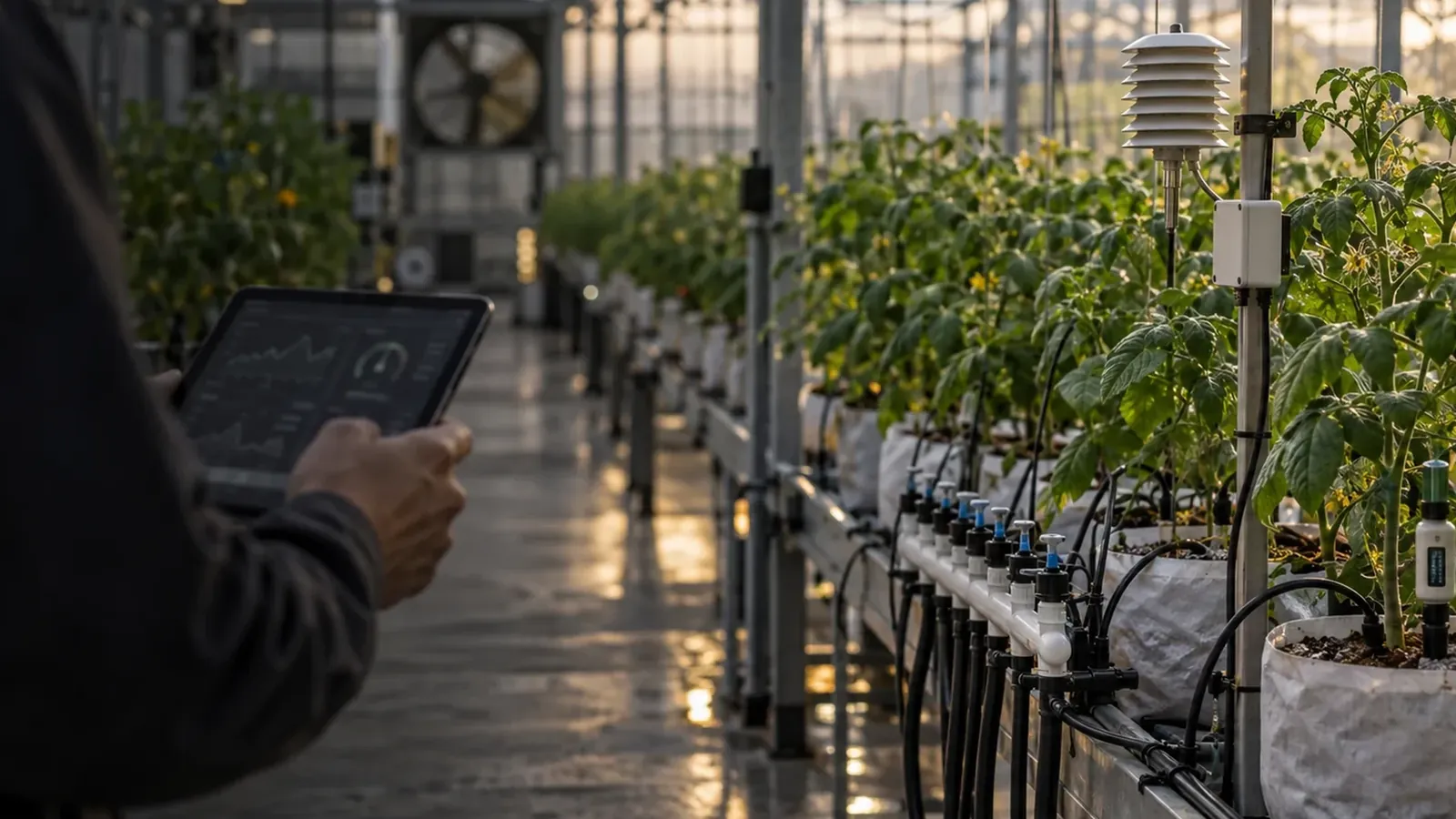
Imagine a vegetable farmer managing a five-hectare farm.
Some sections of the farm are performing well. Others are producing weaker crops, even though the farmer believes they are receiving similar amounts of water, fertiliser and attention.
The farmer suspects that inconsistent soil moisture may be contributing to the problem.
An agricultural expert could explain the relationship between soil moisture, crop growth, irrigation timing and nutrient availability.
A technology engineer could recommend sensors that monitor soil conditions.
A data scientist could develop models to interpret the measurements.
But none of these contributions, on its own, necessarily solves the farmer's problem.
The real challenge is turning specialist knowledge into a system that helps the farmer make better decisions consistently.
This is the kind of challenge an entrepreneurial innovation lab is designed to explore.
At Mindshuttle Labs, our approach is to bring knowledge, technology and practical application together through structured experimentation.
Let's explore how that could work through a hypothetical agricultural Internet of Things (IoT) project.
1. We Start With a Problem, Not a Technology
The project begins with a question:
How can we help farmers make better irrigation decisions while reducing unnecessary water use and protecting crop health?
We do not begin by deciding to build an IoT platform.
We begin by understanding the farmer's environment.
A small discovery team might visit the farm, interview the farmer and observe the existing irrigation process.
They would investigate:
How does the farmer currently decide when to irrigate?
What signs indicate that crops need water?
How does the farmer determine how much water to apply?
What information is unavailable when decisions are made?
What does a wrong decision cost in water, labour or crop performance?
What practical constraints could prevent adoption of a new solution?
We might discover that irrigation decisions depend largely on visual observation, personal experience and routine schedules.
This experience is valuable. The goal is not to replace the farmer's judgement, but to strengthen it with timely, relevant evidence.
Our first hypothesis becomes:
If farmers can understand soil moisture conditions at the point of decision, they may be able to irrigate more precisely and avoid unnecessary watering.
This hypothesis is testable.
And that gives our lab a starting point.
2. Bringing Experts Into the Lab
An innovation lab does not need to possess every form of specialist knowledge internally.
Its strength lies partly in its ability to assemble the right expertise around a clearly defined problem.
For this hypothetical project, we might create a small multidisciplinary team.
Expert Contribution
Agronomist Crop water requirements, soil conditions, irrigation principles
Experienced farmer Operational realities, local practices, usability requirements
IoT engineer Sensors, connectivity, power management and device integration
Data specialist Data quality, analysis and decision-support models
Product designer Farmer workflows, mobile interfaces and adoption
Venture/product lead Problem validation, experimentation, commercial feasibility and delivery
The agricultural expert is especially important.
A soil-moisture sensor can generate a reading, but interpreting that reading requires context.
A reading of 25% volumetric water content does not automatically mean that a crop needs irrigation. Interpretation depends on factors including soil type, crop requirements, root depth and environmental conditions.
The agronomist helps translate these relationships into decision rules that the prototype can evaluate.
The engineer determines how the relevant conditions can be measured reliably.
The product team determines how that information can become something the farmer can use.
The innovation happens through the interaction of these disciplines, not through technology alone.
3. Translating Expert Knowledge Into a Prototype
Now the lab begins turning agricultural knowledge into a working system.
Imagine a basic prototype consisting of soil-moisture sensors installed at selected points, a communications device, a cloud-based application and a simple farmer dashboard.
<text strong={true}>A simplified prototype architecture</text>
flowchart TD
A["Soil moisture sensors"] --> B["IoT gateway"]
B --> C["Data collection"]
C --> D["Agronomic decision rules"]
E["Agronomist expertise"] --> D
F["Crop and soil context"] --> D
D --> G["Farmer dashboard"]
G --> H["Farmer decision"]
H --> I["Irrigation action"]
I --> J["Measure and learn"]
J --> D
<text weight="medium">The crucial component is not the sensor. It is the layer connecting measurements to decisions.</text>
For example, rather than simply displaying:
"Soil moisture: 18%"
The prototype might present:
"Moisture in Zone B is below the agreed operating threshold. Check the soil condition and consider irrigating this zone today."
The threshold would be configured with agronomic input and validated for that crop and soil—not treated as a universal number.
This is a significant product-design shift.
The system is no longer merely presenting measurements.
It is interpreting information in the context of a practical decision.
4. Moving From Information to Behaviour
This is where the experiment becomes particularly interesting.
Consider three versions of the same product.
Version A: The information dashboard
The farmer opens an application and sees soil-moisture readings.
The system provides information.
The farmer must decide what it means.
Version B: The intelligent recommendation
The farmer receives a notification indicating that a particular zone may need irrigation.
The system provides information and interpretation.
The farmer still decides what action to take.
Version C: The behaviour-support system
The farmer receives a recommendation, the reason behind it and a simple way to record a decision.
After irrigating, the system checks whether soil moisture responded as expected.
The farmer can then compare the recommendation with the actual outcome.
The third version introduces a feedback loop.
It does not simply communicate knowledge. It supports a sequence of decisions, actions, observations and improvements.
Our central product hypothesis becomes:
Farmers may derive more value from technology that helps them act on information than from technology that only makes more information available.
5. Testing the Prototype in the Real World
A laboratory prototype is not evidence that a product works in the field.
The next step is a controlled pilot.
We might deploy the system on selected irrigation zones over one growing period, working with the farmer and agronomist to establish a baseline.
The experiment would examine three dimensions.
Technical performance
Are the sensors producing reliable readings? Does data transmission work consistently? Can the system operate under local power and connectivity constraints?
Decision quality
Are the recommendations agronomically appropriate? Can the farmer understand them? Are important conditions being missed?
Behaviour and outcomes
Does the farmer make different irrigation decisions? Are recommendations actually followed? Does water consumption change? Are crop-health and yield outcomes maintained or improved?
For example, we might set a hypothetical target of reducing irrigation water use by 15% without negatively affecting crop performance.
That figure is an experiment target, not an assumed result.
We would also compare against baseline practices, account for rainfall and weather differences, and investigate whether any observed improvement can reasonably be attributed to the system.
An effective prototype must be able to reveal when our assumptions are wrong.
6. Experts Remain Part of the Learning Loop
The system may produce recommendations that do not match field reality.
Perhaps sensors indicate adequate moisture, but the crop is showing signs of stress.
Perhaps the agronomist identifies a soil condition that the initial decision rules did not account for.
Perhaps the farmer repeatedly ignores a recommendation because it arrives at an impractical time.
These are not necessarily failures of the experiment.
They are valuable discoveries.
The agronomist can refine the agricultural logic.
The engineer can improve the measurement system.
The product designer can change how recommendations are delivered.
The farmer can explain why an apparently reasonable action does not fit the realities of the workday.
Every iteration helps the lab develop a more useful understanding of the problem.
Over time, some of the expert's knowledge can be formalised into rules, operating guidance and potentially predictive models.
But expert judgement remains essential for validation, particularly where incomplete data could lead to damaging decisions.
The purpose of intelligent technology is not necessarily to remove the expert. It is to make validated expertise more accessible and actionable.
7. From Prototype to Product
Suppose the pilot demonstrates that farmers can use the system effectively, its recommendations are reliable and its benefits justify its costs.
The project has now moved beyond technical feasibility.
We can begin investigating commercial feasibility.
Could the system work across multiple farms?
Would farmers prefer to buy hardware outright or pay a subscription?
Could agricultural cooperatives deploy it across their members?
Could irrigation equipment suppliers become distribution partners?
What level of maintenance would be required?
How would the economics change for a one-hectare farmer versus a 500-hectare operation?
These questions help determine whether a useful prototype can become a sustainable business.
Within an entrepreneurial lab, the next step might be to develop the technology further, seek commercial partnerships, license the intellectual property or establish a dedicated venture around the product.
Not every experiment should become a company.
Some should be discontinued because the evidence does not support further investment.
Others may become components of larger solutions.
The purpose of prototyping is to create evidence that informs these decisions before substantial resources are committed.
8. What This Experiment Teaches Us
Although our example focuses on farming, the underlying innovation process has much broader applications.
A bank has experts who understand operational risks and compliance requirements.
A hospital has clinicians who understand care pathways.
A manufacturing business has engineers who understand equipment behaviour.
An agricultural business has agronomists who understand crops, soil and environmental conditions.
In every case, valuable knowledge exists.
The challenge is finding ways to connect that knowledge to the everyday decisions and actions that determine outcomes.
The same experimental model can be applied:
Identify the problem → Engage domain experts → Capture relevant knowledge → Build a prototype → Support action → Measure results → Refine or scale.
The technology may differ.
Sometimes it will involve sensors. Sometimes AI, automation, data platforms or redesigned business processes.
But the underlying objective remains consistent.
To make knowledge useful in the environments where decisions are made.
9. The Mindshuttle Labs Perspective
We believe innovation is not simply the process of building new technology.
It is the disciplined process of bringing ideas, expertise, experimentation and execution together to create value.
An IoT farming solution is not valuable because it connects a sensor to the internet.
It becomes valuable when it enables a farmer to make a better decision, take a more effective action or achieve a measurable improvement.
That is the difference between collecting data and solving a problem.
Between possessing knowledge and applying it.
Between building a prototype and discovering a viable product.
At Mindshuttle Labs, this is the kind of journey we are interested in exploring—working across disciplines, challenging assumptions, building experiments and turning promising ideas into solutions that can operate in the real world.
Because the true value of knowledge is not simply what we know. It is what that knowledge enables us to do.
This article presents a hypothetical innovation-lab project to illustrate our approach to multidisciplinary research, prototype development, validation and venture creation. It does not describe an actual completed Mindshuttle Labs deployment.
Mindshuttle Labs | Research. Prototype. Validate. Venture.